Adventures are better shared!
Gaming, well-being, and inclusion: playing to grow as more aware citizens, to nurture our emotional development, our social connections, and our value system
Well-being, social connection, sense of inclusion, emotional awareness, self-esteem, problem-solving.
And furthermore, relational skills, civic values, interpersonal closeness and support, dialogue, and a sense of community.
These are the keywords that best describe our project titled Adventures are better shared! which began around the end of 2024 and will accompany us until the end (or almost ;D) of 2026.
Video games are not only to be understood, learned, mediated, and managed—treated similarly to many other contemporary audiovisual and media phenomena (social media among them)—but they can also be used as tools, within continuous education, to strengthen certain individuals' tutoring, facilitation, and guidance skills.
Gaming Education is precisely this: a collection of approaches and practical, minimally professionalized tools which, when put in the hands of educators, volunteers, tutors, and social workers (essentially, those who work with others in various ways), can prove incredibly useful for enhancing learners' attention, problem-solving skills, self-expression, and value systems. Fundamentally, these are tools designed to improve the competencies of facilitators, bringing them closer to the world of contemporary digital culture and, why not, even bridging some gaps, especially the generational one.
Adventures are better shared! has drawn significant inspiration from Northern European educational traditions which, for some time now, have fostered a keen interest in the potential of video games, coining terms like "EduGaming" and integrating facilitation and tutoring practices with exercises and activities such as co-gaming, guided play, video game sharing, and storytelling through video games.
Adventures are better shared! will therefore, not coincidentally, also focus on somewhat more transversal and, in a sense, intangible aspects: on building networks and fostering connections between European cultural traditions that are often quite different, such as Mediterranean and Nordic, and on encouraging face-to-face conversations between facilitators and gamers. We’ll focus as well on the use and importance of free sharing platforms, often not widely known, and much more.
The partnership for this project is no coincidence; it includes Rafíþróttasamtök Íslands (RÍSÍ), an Icelandic eSports federation already part of our network, and Sverok, a Swedish association that has been promoting online inclusion, well-being through gaming culture—from roleplay to shared gaming—and combating hate speech in virtual and gaming spaces (have you ever played a MOBA…?).
This partnership connects three geographically distant points with the specific goal of bringing them closer together, building a network, and fostering mutual learning. It aims to introduce a bit of Scandinavian culture into the deep south of Europe and, conversely, to bring Mediterranean educational methodologies to contexts and countries that, even within Erasmus+, tend to build somewhat more homogeneous networks. These countries often come with a head start in areas such as resilience and everyday digital competence.
Sharing Stories, Connecting, Networking, Traveling. From EPALE to Digital and Spontaneous Storytelling: The importance of intangible outcomes beyond deliverables
Not that the material products, the deliverables of a project, aren't important—quite the opposite.
. . . And it's not that "Adventures are better shared!" lacks them ;D Just below, we’ve listed everything that we, along with our partners, will produce, with the aim of communicating and disseminating these resources as widely as possible and fully integrating them into our daily operations. In this sense, yes, extending beyond the project's scope and timeline, its milestones and deadlines.
But "Adventures are better shared!" also has, so to speak, more intangible objectives, more connected to the value of an experience, to talking with others, to engaging in dialogue on a given topic, including through the use of virtual and online tools, some of which are more or less familiar to the public.
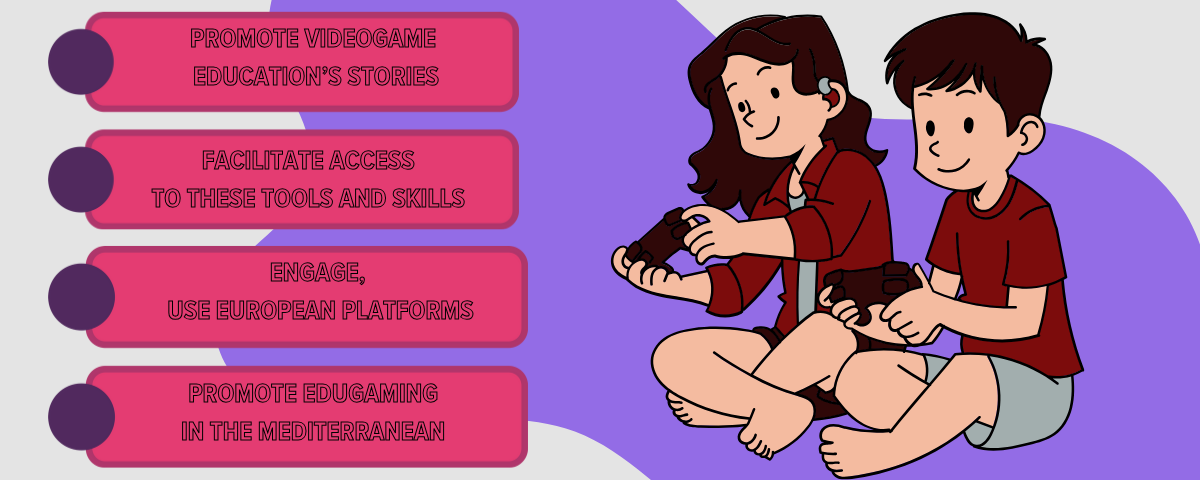
First and foremost, building a European thematic network: bringing together three organizations, each in a sense from Europe’s edges, from the far north to the far south, has meant a lot to us. Our goal is to gradually establish, primarily thanks to our project, a network truly centered on Video Game Education, which can continue offering this educational service beyond the limits and duration of "Adventures are better shared!" and which, above all, can facilitate the circulation of video game-based methodologies even in somewhat more peripheral contexts like those in which Close in the Distance operates.
Then, networking, virtual dialogue, platforms like SALTO and EPALE. Many project activities will take the form of dialogues, discussions, and exchanges, for example through the working groups feature offered by these European platforms we linked earlier. Yes, these activities will produce something—narrative deliverables—but what matters most to us is the significance of the experience: connecting and facilitating conversations among those working in education, facilitation, youth work, and tutoring, directly with European gamers of all ages, proposing a concept of a workshop that goes beyond traditional training, one more based on the acquisition of information, values, and ideas by those most directly involved.
If we want to demonstrate the value of video games as tools (even) for personal growth, why not speak directly with those who have firsthand experience? With those who may feel they have grown, as individuals, precisely through gaming?
And furthermore . . . breaking down barriers.
Why did we choose to invest so much in this project? Let’s clarify one thing: Video Game Education is certainly not something we invented, nor is it exclusive to Scandinavia.
The obstacle? Language, high costs, geographic and cultural distance. And then, the fact that many of the skills transmitted are limited to the use of a specific title, or a particular tool, for example, MinecraftEdu—which we, too, will explore extensively.
Our objective is to make this methodology more democratic and inclusive, contributing to the spread of this slice of digital and audiovisual educational culture that otherwise risks being perceived as “niche,” hyper-specialized, accessible only to those who are already trained and invested, who have a genuine interest in video games, an extensive set of linguistic skills, as well as time and personal resources, and so on.
SALTO and EPALE will serve us well in this regard: to promote resources and initiatives accessibly, openly, and freely to a broad audience of stakeholders, to publish and communicate Videogame Education without filters and, as far as possible, without barriers. And finally, mobility. Adventures are better shared! incorporates one of the most wonderful aspects of Erasmus+: traveling and learning from diverse traditions and people, even for those without full access to such opportunities.
Our project includes selecting four educators, tutors, volunteers, facilitators to visit Sverok’s headquarters in Stockholm, Sweden—our mentor partner—covering travel costs. The objective? To explore and experience firsthand what Edugaming loosk like once established, once they become a 'traditional' practice in mature contexts and organizations.
The selection criteria will primarily consider economic need, interest in our project activities, and lack of access to similar educational mobility opportunities in the past two years.
Activities and Outcomes
The Adventures are better shared! project will develop and share:
-Interactive interviews with young and adult gamers across Europe, using modules and forms inspired by digital storytelling methodology, to be compiled into an anthology for those working in education, tutoring, and educational facilitation. This anthology will offer a “real” overview of the benefits many individuals have gained from video games, from playing online and with others (or even solo!).
-Working, dialogue, and sharing groups on EPALE, involving gamers and professionals in education, lifelong learning, social activities, and tutoring, to collaboratively explore the potential and possible uses of gaming, especially for enhancing civic, cultural, and inclusion skills. The goal is also to help raise awareness of the European Commission's adult learning platform, even among those not fully familiar with it. We will also use SALTO, the platform dedicated to youth, to amplify this networking, dialogue, and sharing initiative as broadly as possible
-Learning and skill-building activities for educators, tutors, and facilitators (as well as trainers and social workers) focusing on Videogame Education, with practical examples and tools
-An educational mobility opportunity at Sverok’s headquarters in Stockholm, Sweden, open to participants and target groups with fewer economic resources (learners)
-Various dissemination and communication content and several articles on EPALE and SALTO, specifically dedicated to the themes of digital culture, gaming, and promoting the development of transversal skills through online culture and virtual tools.
All resources and activities will be available in multiple languages (Italian, English, Icelandic, Swedish) and will be accessible on the partner websites. The EPALE group will operate in English, but if you want to participate and don’t feel comfortable reading or writing in a foreign language, the Close in the Distance, Sverok, and RÍSÍ teams will support you with translations and adaptations as needed.
For more information, visit our Instagram page, EPALE, our Blog, or contact us directly via the Contacts page or email us at direttivo@closeinthedistance.com.
The full title of Adventures are better shared! is "Adventures are better shared! A Guide for Educators and Facilitators in Video Game Education," and its acronym is also "Gamingway!". The project identification code is 2024-1-IT02-KA210-ADU-000246576.
Co-funded by the Erasmus+ Program of the European Commission, this is an Erasmus+ KA210 project, a Small-Scale Partnership in the Adult Education sector. The project began on September 1, 2024, and will end on August 31, 2026 (24 months in duration). Close in the Distance, Sverok, and Rafíþróttasamtök Íslands received EUR 48,000.00, representing 80% of the total co-funding, from the Italian Erasmus+ National Agency I.N.D.I.R.E, to launch the various planned activities.
Funded by the European Union. Views and opinions expressed are however those of the author(s) only and do not necessarily reflect those of the European Union or the European Education and Culture Executive Agency (EACEA). Neither the European Union nor EACEA can be held responsible for them.